
Costa Rica water- it’s a favorite topic of first-time visitors to Costa Rica. In fact, the most commonly asked question I get about visiting Costa Rica is whether or not it’s safe to drink tap water.
I probably get this question because the water quality throughout Latin America can be iffy at best, and travelers are just used to drinking bottled water when they travel.
But if you have to buy bottled water for your travels, the expense can add up fast- especially for a family. In this post, I’ll outline when to drink from the tap, where the water comes from in Costa Rica, what to do about Costa Rica water in rural areas, and what you can do if you don’t feel comfortable drinking the water.
RELATED POST: Costa Rica With Kids- The Complete Guide

Can you drink the water in Costa Rica?
The short answer is yes. You can drink tap water in Costa Rica safely in almost every part of the country. In some rural areas, including the Caribbean Coast and non-touristy places, you may want to stick with bottled water.
Let’s go into a little more detail.
Costa Rica thrives on tourism- it is the #1 industry in the country and the government wants to keep it that way. This means that the Costa Rican government works hard to bring tourists what they need to stay safe and happy.
Plus, Costa Rica is an eco-tourism hot spot. The government also takes into consideration the environmental impact of the constant use of single-use plastic bottles. There are recycling bins everywhere in Costa Rica, so if you do choose to drink bottled water, please recycle.
In urban areas (such as San Jose) you will find the drinking water to be safe, which means you can also safely eat raw fruits and vegetables. (Thank goodness because the fresh fruit juices are absolutely amazing.)
Water from the tap runs clear, and has been filtered multiple times. Costa Ricans drink the water with few to no problems.
You may find a higher concentration of minerals and chlorine in the water in Costa Rica, so if you have a sensitive stomach, you may want to be careful. I would imagine that is true in any country though. The water in Costa Rica is hard, not soft. Fluoride is not added to the water.
If you are staying long-term or moving to Costa Rica permanently, I would just check the source of your water. You can purchase home water filters if you feel the mineral content is too high.
Bottled water is available widely, you can expect a 12-ounce bottle of water to cost about $1. You can find water for sale in even the most rural areas. You can also buy water by the gallon, which definitely saves on the number of plastic water bottles.
If you are not sure if you should drink the water, just ask a local. They will tell you the truth honestly.
RELATED POST: The Complete Costa Rica Currency Guide

Why is Costa Rica water safe?
You might not believe me and my opinion, so I’ll give you a little background on the water system in Costa Rica. If you want to get really geeky about it you can read this article on reverse osmosis in Costa Rica.
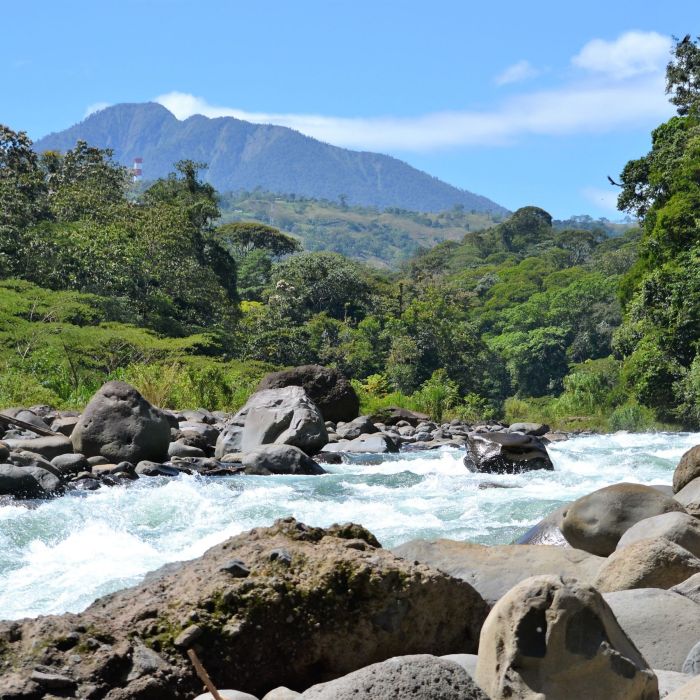
There are tons of freshwater rivers running through Costa Rica, so rural areas don’t have to do a ton of filtering. There is also a huge influx of rain during the rainy season, providing more water that isn’t hard to filter. Well-water is also abundant outside of large urban areas.
However, let’s talk about the main source of water purification in Costa Rica.
The A y A, which is the institute for aqueducts and sewers, is in charge of providing water to the country. You will see A y A offices in almost every city, town, and village.
You will also see A y A workers constantly checking the water supply for purity. Oftentimes, the water will just be shut off for a day or so as construction on water pipes and checks for water purity happen.
The bottom line is that Costa Rica takes water safety very seriously for both its residents and tourists.
What to do about Costa Rica water in rural areas
The only exception to water purity in Costa Rica I have found is in either rural areas (small towns) or some rural beach areas.
Some beach areas, especially on the Caribbean side, seem to have trouble with the desalination process and therefore the water filters become clogged.
Near the volcanoes, it is harder to filter the water because there are more minerals in the water. You might want to take this into consideration if you are worried about a high concentration of minerals.
You can always ask a local what their water source is. If it’s the A y A or well water, you can be pretty sure it’s safe. If there is a water tank you can have problems (this happens mostly in beach areas) because the water can become stagnant if not changed out frequently and properly.
Costa Ricans will always tell you if their local water is generally consumed safely by tourists. The one thing Costa Ricans absolutely hate is when tourists have any sort of problem, no matter how minor, in the country. They will tell you the truth.
Drinking Water Accessories You Can Take With You
If you feel ok about drinking Costa Rica water, please make sure to bring along a reusable water bottle on your trip. We love to bring the double-walled ones that keep water cold all day.
If you aren’t feeling kosher with the water situation, and you want to take along your own accessories to Costa Rica, here are a few that I recommend:
Life Straw Water Bottles
These water bottles filter out everything. You can even drink from a river with these and the filter works like a charm. Life Straw products are used in third-world countries where drinking water is not safe, and buying bottled water is cost-prohibitive. (Example: Africa.)
Water purification tablets
These can be easy to carry and used only when needed. They aren’t bulky either. The only downside is that
Anti-diarrheal pills
Pills can be handy if you do get sick to lessen the effects.
What To Do If You Get Sick
You can easily buy anti-diarrheal pills widely in Costa Rica- they are even sold in grocery stores and pulperias. The brand most widely used in Costa Rica is Alka-D which comes in both powder and pill form and are cheap. You can even buy a single pill at a time to save on expenses.
If your symptoms persist you can always visit a pharmacy and talk to the pharmacist. This is common practice in Costa Rica before seeing a doctor, and it’s a nice free option.
If you would like to talk to me about a customized itinerary or specific Costa Rica travel advice for your family, (zero sales- just advice!) check out my “Ask Christa” page for more information on custom Costa Rica trip planning geared towards families.
You might also like:
- Driving In Costa Rica – Complete Guide
- Best Costa Rica Travel Guidebooks
- Costa Rica Weather
- Tipping in Costa Rica
- All about Mosquitos In Costa Rica
- Tipping in Costa Rica
- 30+ Foods To Try In Costa Rica
- Costa Rica Currency
- The Complete Guide To Costa Rican Slang
- 50 Interesting Costa Rica Facts You Need To Know